
1. What gets the morning started?
Near Volcano, the forest begins the day with sound: whistles, buzzes and rolling songs coming down from the canopy. It’s worth listening before trying to put names to anything; the calls make the green overhead feel busy and close.
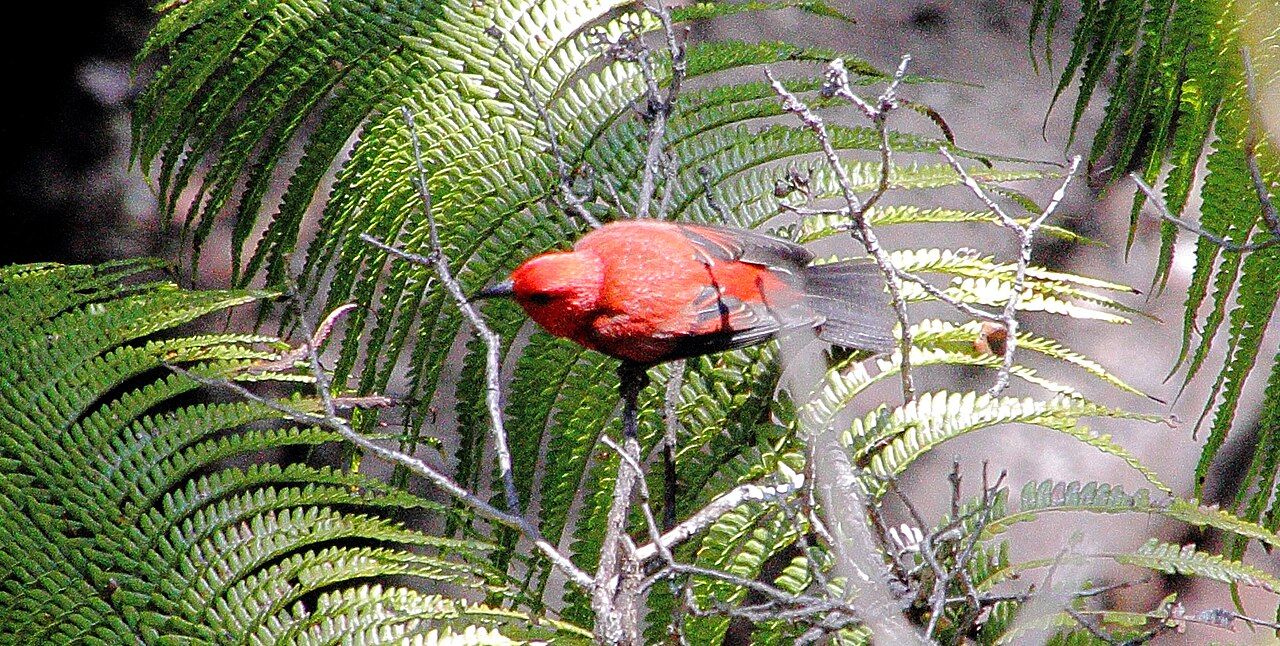
Then look up. A flash of crimson among red flowers might be an ʻapapane, while a small yellow-green bird moving along a branch could be an ʻamakihi. A few familiar names turn the forest from a blur into a community, and that’s a pleasing way to begin a walk.
2. Which tree holds the forest together?
It’s hard to miss ʻōhiʻa lehua once its range of shapes comes into view. On fresh lava, it grows low and twisted; in deeper soil, it can rise into a tall canopy tree, its dark bark rough beneath the flowers.
The lehua blossoms look like bright pompoms made of stamens, usually red, though yellow, orange and pink flowers appear too. ʻŌhiʻa is often the first tree to colonize new lava, and its flowers feed honeycreepers while its branches shelter insects and spiders. Below, its shade gives the ferns their place in the forest.
The tree and its flowers also turn up in Hawaiian stories, often alongside Pele and the forest goddesses. I’m especially fond of the way ʻōhiʻa can look so different from one patch of ground to the next, while still being the tree that ties the whole scene together.
3. What should a walk teach about rapid ʻōhiʻa death?
Since the 2010s, rapid ʻōhiʻa death has killed large numbers of ʻōhiʻa on Hawaiʻi Island. Fungi enter through wounds and block the tree’s flow of water; the crown can turn brown within weeks, leaving gray, bare stands among living forest in parts of Puna and elsewhere.
There’s no simple cure, so prevention belongs in the day’s routine. Soil and plant matter can travel on boots, clothing and gear, and many trailheads have brushes and sprays. Clean those items before and after a walk, and don’t carry ʻōhiʻa wood, leaves or flowers between areas.
Wounds matter, too: don’t carve a trunk, tie a rope to it or break a branch. Mud on a vehicle should be washed off after driving forest dirt roads. Young ʻōhiʻa face other diseases, including a rust that spots leaves and stems, so growers around Volcano village watch their seedlings closely.
4. What grows beneath the ʻōhiʻa canopy?
Hāpuʻu tree ferns fill the lower forest with great fronds that unroll from tight, furry coils at the tops of fibrous trunks. In the wettest places they make a second canopy, and the path into Nāhuku lava tube passes beneath them.
That fern layer has its own history. The soft golden fiber on young fronds, called pulu, was once gathered and shipped off the island for pillow and mattress stuffing, a trade that damaged many stands. Hāpuʻu are protected in the park now and grow slowly, so leave their fibers, fronds and trunks where they are.
On younger lava, ʻamaʻu is another native fern to notice. Its new fronds can be striking red before turning green, and the plant is among the first to colonize fresh flows. I like the small color change; it gives the forest floor a quiet surprise without asking for much attention.
5. Which birds are calling from the canopy?
The ʻapapane is the bird most likely to turn up: crimson, with black wings and tail and a slightly curved black bill. It feeds on ʻōhiʻa nectar and often moves in small, busy groups through flowering trees, with whistles, buzzes and clicks in its varied, constant call.
The Hawaiʻi ʻamakihi is smaller and yellow-green, with a down-curved bill and a black mark around its eye. It works quickly through foliage, picking insects and sipping nectar. Stay still for a while and there may be an ʻōmaʻo’s fluting song, or a glimpse of the rarer ʻiʻiwi, scarlet with a long, curved salmon-colored bill.
These birds survive mainly in higher forests like this, where cooler temperatures keep mosquitoes that spread avian malaria in check. The forest’s health matters to their future, which makes listening here feel less like collecting sightings and more like noticing what the trees support.
6. What changes as the day moves toward dusk?
In open lawns and along roadsides, the nēnē may be easier to notice than the birds overhead. Hawaii’s goose and state bird has a black head, buff cheeks and dark furrows along its neck. It walks more than it swims, grazing on grasses and berries.
By the mid-twentieth century, only a few dozen nēnē remained in the wild. Protection and breeding programs brought the population back, though the species is still vulnerable, and cars remain a major threat. Nēnē are used to people and may approach, so a close encounter isn’t an invitation to feed one.
Give a nēnē space and the right of way if it’s on a path or road. Drive slowly in the park and in Volcano, especially at dawn and dusk. That’s a simple way to share the road without turning the bird’s tolerance of people into a danger.
7. How does a good bird walk wind down?
The first few hours after sunrise are the best time for watching, before the wind picks up. Short summit-area trails, including Kīpukapuaulu off the Mauna Loa road, are good places to start. Walk slowly, stop often and give your ears as much work as your eyes.
Binoculars help, but stillness helps too. Stand under a flowering ʻōhiʻa for ten minutes and birds may come to you. As the day winds down, I’d take that pause over hurrying from one view to another; the forest has plenty going on at branch level.
8. What belongs in the field notes?
- Listen for ʻapapane calls and watch flowering ʻōhiʻa for honeycreepers.
- Clean soil and plant matter from boots, clothing and gear before and after walking.
- Leave nēnē space, never feed them, and drive slowly around the park and Volcano.
For another walk through this landscape, continue with the notes on Kīlauea Iki trail.
Read next: A walk from forest to lava lake